TL;DR

Get movie nights delivered free with Prime
- Fast, free delivery on millions of items
- Prime Video, Amazon Music and more included
- Member-only deals all year
Walt Disney Animation Studios describes animated filmmaking as a collaborative process spanning story development, visual design, casting, technology, shot production and post-production. Its account shows how artists, production teams and technologists work together, while leaving project-specific schedules and budgets unspecified.
Walt Disney Animation Studios has outlined how its animated films move from early story development to final picture and sound delivery, describing a production process that brings together storytellers, artists, actors, technicians and production staff. The account offers a view of the work behind a finished film, while describing the studio’s own process rather than setting out a universal production timetable.
The process begins in development, where storytellers shape the narrative and artists explore the appearance of characters and settings. The studio says its editorial and sound teams help piece together evolving story ideas as production takes shape. Casting is another part of this early work: the studio describes finding actors whose performances can give the characters voices.
Before and during production, the studio’s Production Training and Development team provides classes, workshops, lectures, screenings, field trips and other learning experiences. Artists can also consult the Walt Disney Animation Research Library, which the studio says holds more than 65 million assets from nearly a century of Disney Animation history. Those materials can serve as reference and inspiration during a film’s creation.
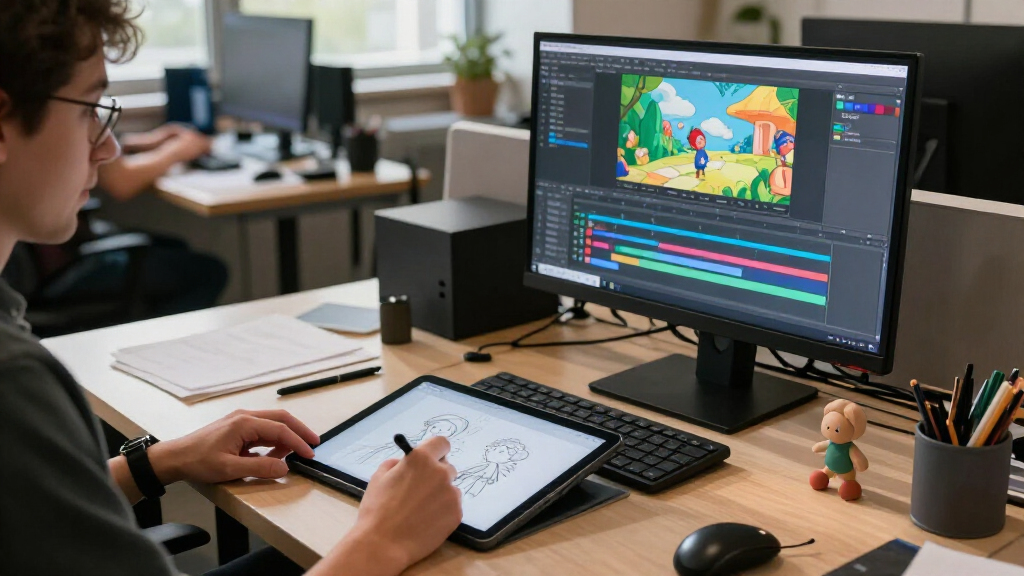
In pre-production, concept drawings and visual development are turned into three-dimensional models of characters and environments. Artists create rigs, which provide structures for movement, and textures that define how surfaces look. Production management tracks changing schedules, while technical directors address production problems and support the tools and software used by artists.
Once the characters and environments are prepared, teams begin shot production: creating the scenes that form the movie, frame by frame. Disney says this work can include character acting as well as details such as hair, clothing and the surrounding world. Technology teams develop visualization, collaboration and rendering tools, which the studio says are intended to support higher-quality images and faster iterations.
The process concludes with post-production, where picture and sound are shaped for final delivery. When a production wraps, its art and assets are organized and archived in the Research Library for use across the Walt Disney Company. The studio presents the film as the result of collaboration across production, technology and other studio teams.
How Many Teams Shape Each Frame
The studio’s outline makes clear that animation is not only the work of animators. A finished scene depends on decisions made across story, design, performance, software and production planning. That helps explain why changes to a character, setting or sequence can involve people in several departments, not just the artist working on a frame.
The account also points to technology as part of the creative process. Models, rigs and rendering systems provide the means to build and present the film’s images, while collaboration tools help teams exchange work. For viewers, these steps explain how a drawn concept can become a moving character in a detailed environment. For people interested in film production, they show the range of specialized work behind a release.
Popular right now

Breville Bambino Espresso Machine, Brushed Stainless Steel

KitchenAid Artisan 5-Quart Tilt-Head Stand Mixer, Almond Cream

KitchenAid Artisan Series 5-Quart Tilt-Head Stand Mixer, Dried Rose (KSM150PS)
As an affiliate, we earn on qualifying purchases.
From Concept Art to Final Delivery
Disney Animation presents filmmaking as a sequence of connected stages, but its description also indicates that some work overlaps. Training and research can continue during production, and editorial teams help guide story ideas as the film develops. The outline therefore describes a workflow, not a simple handoff in which one department finishes before the next begins.
The studio identifies technology as part of its production pipeline and says artists and technologists work together on tools and workflows. Its Research Library is described as a resource during production as well as an archive after a film wraps. The page also promotes Zootopia 2 as playing in theaters, but gives no production-specific information about that title in the process description.
““Once our characters have been crafted and our environments realized, we begin the process of creating the scenes that will comprise our movie.””
— Walt Disney Animation Studios
Details the Studio Does Not Give
The page is a high-level description of Disney Animation’s process, not a production report about a specific film. It does not state how long each stage takes, how many people work on a typical project, how much a film costs or how often the workflow changes. It also does not explain the precise division of responsibilities across all departments or describe the tools used on individual productions.
The studio’s statements about faster iteration and higher-quality visualization describe the aims of its technology work; the page provides no measurements or comparisons to quantify those outcomes. The account should not be taken as a description of every animation studio, which may use different pipelines and methods.
How the Workflow Continues
For any individual film, the next production steps depend on its own story, schedule and creative decisions. The studio’s outline indicates that teams move from development and asset creation into shot production, then refine picture and sound before final delivery. It does not provide dates for those milestones or announce a new process change.
After a production wraps, the studio says its art and assets are organized and archived for reference. Its process page also lists Zootopia 2 as playing in theaters, but does not connect that release notice to a new production update.
Key Questions
What is the first stage of making an animated film?
Disney Animation says the process begins with development, where storytellers work on the narrative and artists define the look of characters and worlds.
How do characters become three-dimensional?
Artists turn visual development and concept drawings into models, rigs and textures. These define the character’s form, how it can move and how its surfaces appear.
What happens during shot production?
Teams create the scenes that make up the film. Disney says the work can include character acting and details such as hair, clothing and elements of the environment.
Is this process used by every animation studio?
No. This is Walt Disney Animation Studios’ description of its own filmmaking process. Other studios may organize their teams and production pipelines differently.
How long does it take to make an animated film?
The studio’s process description does not give a typical production length. Timing can depend on the individual film, and the source does not provide a schedule or project-specific estimate.
Source: disneyanimation.com