A beauty room can collect fine dust, hair, product odors, and airborne particles from everyday services, so I’d choose a purifier by matching its cleaning pace to the room—not by relying on the largest coverage claim alone. My leading picks are the Blueair Blue Pure 311i Max for quiet, sensor-led operation, the LEVOIT Vital 200S-P for larger rooms and independently verified performance, and the Levoit Core 300-P for a balanced mix of particle filtration and straightforward controls. Those strengths suit different setups: a busy, larger treatment area benefits from greater airflow, while a compact room may be better served by a smaller unit that is easier to place near the work area.

Get movie nights delivered free with Prime
- Fast, free delivery on millions of items
- Prime Video, Amazon Music and more included
- Member-only deals all year
The main tradeoff is cleaning speed versus footprint and convenience. The Afloia KILO offers a washable pre-filter and very quiet sleep mode, but its broadest coverage claim is tied to a slower one-hour cleaning period. The Core Mini-P is the easiest to fit into a tight space, though its listed details do not establish the room-cleaning capacity needed for a larger salon. I rank these options by the usefulness of their stated particle-cleaning information, fit for beauty-room workflows, noise and controls, and the clarity of their tradeoffs.
Complete the kit


Key Takeaways
- The Blueair 311i Max is my pick for a treatment room where quiet operation, automatic fan adjustment, and app monitoring matter more than a minimal control setup.
- The LEVOIT Vital 200S-P offers the strongest large-room case in this lineup, with AHAM verification and smoke, dust, and pollen CADR figures to compare.
- The Core 300-P is a practical middle ground: it gives specific CADR figures and quiet sleep mode, but has no smart connectivity or Auto Mode.
- Afloia KILO’s 1,500-square-foot figure is based on one hour of cleaning; its four-air-changes-per-hour figure applies to rooms up to 374 square feet.
- The Core Mini-P suits a small station or compact room, but its supplied specifications do not state a coverage area or CADR for checking cleaning speed.
| Blueair Blue Pure 311i Max Smart Air Purifier |  | Best Overall for Quiet, Sensor-Led Rooms | Coverage: 439 sq ft in about 12.5 minutes; up to 2,107 sq ft in 1 hour | Filtration: HEPASilent dual filtration | Particle capture: 99.97% of airborne particles down to 0.1 microns | VIEW ON AMAZON | See Our Full Breakdown |
| LEVOIT Vital 200S-P Smart Air Purifier for Large Rooms |  | Best for Large Beauty Rooms | Coverage area: Up to 1,875 sq ft | CADR, smoke: 250 CFM | CADR, dust: 254 CFM | VIEW ON AMAZON | See Our Full Breakdown |
| Levoit Core 300-P Air Purifier |  | Best Balanced Pick for a Single Treatment Room | Filtration: 3-in-1 filtration | Particle efficiency: 99.97% for 0.1–0.3 micron particles | CADR: 143 CFM smoke; 153 CFM dust; 167 CFM pollen | VIEW ON AMAZON | See Our Full Breakdown |
| Afloia KILO Air Purifier with 4-Stage Filtration |  | Best for Quiet Operation and a Washable Pre-Filter | Filtration: 4-stage | Air changes: 4 per hour for rooms up to 374 sq ft | Coverage claim: Up to 1,500 sq ft in one hour | VIEW ON AMAZON | See Our Full Breakdown |
| Levoit Core Mini-P Air Purifier |  | Best Compact Pick for a Small Station | Model: Core Mini-P | Dimensions: 6.5 × 6.5 × 10.4 in | Noise level: 27–45 dB | VIEW ON AMAZON | See Our Full Breakdown |
| air purifier for beauty room | Filtration | Noise level |
|---|---|---|
| Blueair Blue Pure 311i Max Sma | HEPASilent dual filtration | 23–50 dB |
| LEVOIT Vital 200S-P Smart Air | — | — |
| Levoit Core 300-P Air Purifier | 3-in-1 filtration | — |
| Afloia KILO Air Purifier with | 4-stage | 22 dB in sleep mode |
| Levoit Core Mini-P Air Purifie | — | 27–45 dB |
More Details on Our Top Picks
Blueair Blue Pure 311i Max Smart Air Purifier
I rank the Blueair 311i Max first for beauty rooms where appointments happen close together and a purifier needs to run in the background without frequent manual adjustments. Its air-quality sensors, automatic fan adjustment, app control, scheduling, and filter-life tracking make it the most hands-off option here. The stated noise range of 23–50 dB gives buyers a clearer sense of its operating range than several competing listings provide, although the loudest setting may still be noticeable during a quiet consultation.
Its stated cleaning rate is helpful for matching the unit to a treatment room: Blueair says it can clean 439 square feet in about 12.5 minutes, while the larger figure of up to 2,107 square feet is based on one hour. I would not compare that hourly reach directly with a faster room-cleaning claim. The 360-degree intake may also make placement less restrictive than a purifier that needs a particular side facing the room. Against the LEVOIT Vital 200S-P, the Blueair brings more explicit automation and a stated noise range, while the LEVOIT offers AHAM verification and separate smoke, dust, and pollen CADR values.
The HEPASilent dual filtration is listed to capture 99.97% of airborne particles down to 0.1 microns, including dust, pollen, pet dander, mold particles, and smoke. That is useful particle-focused information, but I would not read it as a promise to remove every salon vapor or product fragrance. Filter replacement remains part of ownership, and the supplied details do not remove that recurring maintenance task. I’d choose it over the Core 300-P when automatic monitoring and connected controls matter; I’d choose the Core 300-P instead for a simpler setup with published CADR figures and fewer smart features to manage.
Pros:- Air-quality sensors can adjust fan speed automatically.
- App functions include scheduling and filter-life tracking.
- Stated noise range of 23–50 dB helps set expectations.
- 360-degree intake allows flexible placement.
Cons:- Its coverage figures use different cleaning times and are not directly interchangeable.
- Filter replacement reminders reflect ongoing maintenance and replacement needs.
Best for: Beauty professionals who want app controls, automatic fan changes, and a stated cleaning pace for a treatment room.
Not ideal for: Buyers who want the simplest possible controls, or those who prefer a product listing with one unambiguous coverage figure rather than separate rates tied to different cleaning times.
- Coverage:439 sq ft in about 12.5 minutes; up to 2,107 sq ft in 1 hour
- Filtration:HEPASilent dual filtration
- Particle capture:99.97% of airborne particles down to 0.1 microns
- CADR:250 for smoke, dust, and pollen
- Noise level:23–50 dB
- Air intake:360°
- Smart features:Sensors, automatic fan adjustment, app control, scheduling, filter-life tracking
Our verdict“I’d choose the Blueair 311i Max for a beauty room that needs quiet, automatic particle-focused operation and convenient monitoring.”
LEVOIT Vital 200S-P Smart Air Purifier for Large Rooms
The Vital 200S-P is my large-room pick because its stated capacity is backed by AHAM verification and separate CADR figures, giving buyers more to work with than a broad area claim alone. Smoke CADR is 250 CFM, dust is 254 CFM, and pollen is 289 CFM. For a beauty room that shares space with reception, retail shelving, or multiple work stations, that combination makes it the most convincing choice in this group when the room itself is the main challenge.
LEVOIT lists coverage up to 1,875 square feet and includes both a traditional inlet and a U-shaped inlet intended to capture airborne pet hair without clogging. That intake detail may appeal to a studio that also has pets nearby or deals with loose hair, though it does not replace routine cleaning or filter changes. Compared with the Blueair 311i Max, the Vital’s strongest distinction is its verified large-room positioning and clear pollutant-specific CADR figures; Blueair has more detailed noise information and a fuller list of connected controls. The supplied Vital details do not state noise level or energy use, so I cannot rank it as confidently for rooms where conversation volume or operating cost leads the decision.
Multiple replacement filter options—Toxin Absorber, Smoke Remover, and Pet Allergy—let buyers choose a filter direction based on their priorities. I would still check the exact filter’s intended use rather than assuming the purifier removes every chemical odor associated with beauty products. This model ranks ahead of the Core 300-P for larger spaces, while the smaller Levoit is easier to assess for a modest room because its listing includes a sleep-mode noise figure and a simpler feature set. The Vital makes the most sense when room size and verified particle-cleaning data take priority over a compact footprint.
Pros:- AHAM-verified, with separate smoke, dust, and pollen CADR values.
- Designed for rooms up to 1,875 square feet.
- U-shaped and traditional inlets address different intake needs.
- Multiple replacement filter options target different priorities.
Cons:- The supplied details do not state noise level or energy consumption.
- Large-room capacity may be more than a compact treatment room needs.
Best for: Owners of larger beauty rooms or shared studio spaces who want AHAM-verified performance data and distinct filter options.
Not ideal for: Buyers who need published noise and energy figures before choosing, or who have a small room and do not need a large-room model.
- Coverage area:Up to 1,875 sq ft
- CADR, smoke:250 CFM
- CADR, dust:254 CFM
- CADR, pollen:289 CFM
- Verification:AHAM VERIFIDE
- Air inlets:Traditional inlet and U-shaped inlet
- Replacement filter options:Toxin Absorber, Smoke Remover, and Pet Allergy
Our verdict“I’d pick the Vital 200S-P when a large beauty room and independently verified particle-cleaning figures matter more than detailed noise data.”
Levoit Core 300-P Air Purifier
The Core 300-P earns its place as my balanced, no-frills treatment-room choice. It pairs specific CADR figures—143 CFM for smoke, 153 CFM for dust, and 167 CFM for pollen—with a 3-in-1 filter listed to capture 99.97% of particles measuring 0.1–0.3 microns. That gives me a clearer basis for comparing its particle filtration with the compact Core Mini-P, whose supplied specifications do not include a CADR or coverage area. For a room that needs meaningful filtration without a connected app, the Core 300-P is the more defensible choice.
Its coverage claim reaches up to 1,073 square feet, but buyers should pair that figure with the CADR and their preferred cleaning pace rather than assume it will clean every room equally fast. Sleep Mode runs at 24 dB, and the timer, check-filter indicator, and switchable display lights help make it easier to fit around appointments or after-hours operation. The Blueair 311i Max is the better fit when automatic adjustments and app tracking are priorities; the Core 300-P is simpler, with fewer smart features and a more direct control approach.
The tradeoff is a lack of smart connectivity and Auto Mode. A beauty professional who wants the purifier to respond automatically to changing air conditions may prefer Blueair. Filter replacement is recommended every six to eight months, so upkeep is still part of the routine, and this model is specified for 120 V use in the United States. I place it ahead of Afloia KILO for buyers who value stated CADR numbers; Afloia counters with a washable pre-filter, lower stated sleep noise, and more timer choices.
Pros:- Lists smoke, dust, and pollen CADR figures.
- Sleep Mode is specified at 24 dB.
- Timer and display-light controls suit after-hours use.
- AHAM Verified, FCC Certified, ETL Listed, and CARB Compliant.
Cons:- No smart connectivity or Auto Mode.
- Replacement filters are recommended every 6 to 8 months.
- Specified for 120 V use in the United States.
Best for: A beauty professional seeking a straightforward purifier with stated CADR figures, quiet sleep mode, and no need for app-based control.
Not ideal for: Buyers who want automatic fan adjustment, mobile monitoring, or a purifier specified for use outside the United States.
- Filtration:3-in-1 filtration
- Particle efficiency:99.97% for 0.1–0.3 micron particles
- CADR:143 CFM smoke; 153 CFM dust; 167 CFM pollen
- Coverage area:Up to 1,073 sq ft
- Sleep Mode noise:24 dB
- Power:56 watts; AC
- Filter replacement interval:Every 6 to 8 months
- Dimensions and weight:8.7 × 8.7 × 14.2 in; 7.9 lb
Our verdict“I’d choose the Core 300-P for a single treatment room where clear particle-cleaning data matters more than app control.”
Afloia KILO Air Purifier with 4-Stage Filtration
Afloia KILO stands apart by combining a washable pre-filter, adjustable fan speeds, and a 22 dB sleep mode. For a beauty room where loose hair and visible dust are regular nuisances, being able to wash the pre-filter can make basic upkeep feel more manageable. Its small listed footprint—8 × 8 × 15 inches—and 4.8-pound weight also make it easier to relocate than a larger room-oriented option such as the LEVOIT Vital 200S-P.
I would pay close attention to the two different capacity statements. Afloia lists four air changes per hour for rooms up to 374 square feet, while the claim of up to 1,500 square feet is based on one hour. That larger figure may sound comparable with the coverage listed for the Vital, but it describes a slower cleaning pace than a typical room rating intended to show repeated air changes. For a working treatment room, I would use the 374-square-foot, four-air-changes-per-hour figure as the more practical reference when matching the purifier to a room.
The KILO also offers timers from two to 16 hours and a seven-color light with auto-dimming in sleep mode. These extras may be welcome in a room that doubles as a personal space, though decorative lighting is secondary to airflow and filtration for most salon work. Its listing gives a four-stage system and activated-carbon filter type, but does not include pollutant-specific CADR figures, making it harder to compare cleaning performance directly with the Core 300-P or the AHAM-verified Vital. Filter replacement is recommended every four to six months, so its washable pre-filter does not eliminate replacement maintenance. I rank it below the Core 300-P for data-driven selection, but above the Mini-P when quiet operation and room information matter more than a tiny footprint.
Pros:- Washable pre-filter helps with dust and pet hair.
- Sleep mode is listed at 22 dB.
- Timer settings run from 2 to 16 hours.
- Compact, lightweight design is easy to move.
Cons:- The 1,500-square-foot claim is based on one hour of cleaning.
- Replacement filters are recommended every 4 to 6 months.
- No pollutant-specific CADR figures are supplied.
Best for: Buyers who value very quiet operation, a washable pre-filter, and a compact unit for a room within its four-air-changes-per-hour rating.
Not ideal for: Anyone choosing primarily by the 1,500-square-foot claim or seeking pollutant-specific CADR data for direct comparison.
- Filtration:4-stage
- Air changes:4 per hour for rooms up to 374 sq ft
- Coverage claim:Up to 1,500 sq ft in one hour
- Noise level:22 dB in sleep mode
- Filter and pre-filter:Activated carbon filter; washable pre-filter
- Power:23 watts
- Timer and fan:2, 4, 8, or 16 hours; adjustable fan speeds
- Dimensions and weight:8 × 8 × 15 in; 4.8 lb
Our verdict“I’d choose the KILO for a smaller beauty room where quiet sleep mode and washable pre-filter maintenance outweigh the lack of CADR figures.”
Levoit Core Mini-P Air Purifier
The Core Mini-P is the smallest, most space-conscious option in this roundup, with a footprint of just 6.5 × 6.5 inches and a height of 10.4 inches. I see it as a personal-space or small-station purifier, not a proven substitute for a room-sized unit. Its pre-filter and main filter are described as capturing hair, lint, pet dander, smoke particles, and other fine airborne pollutants. That can make it appealing beside a desk, reception counter, or compact service nook where a larger purifier would crowd the work surface.
Noise is listed at 27–45 dB, and the model includes sleep mode, an auto-off display, and an aromatherapy feature. Those touches give it a different role from the Core 300-P: the larger model supplies CADR and coverage information, while the Mini-P prioritizes compact placement and simple ambient features. If the goal is to treat a full beauty room rather than a small station, I would move up to the Core 300-P or consider the Blueair 311i Max, both of which provide more useful room-cleaning information in the supplied details.
The most significant gap is that the product information here does not state a coverage area, CADR, or filter replacement interval. I would not infer a room-cleaning rate from the compact size or pollutant list. The aromatherapy tray also requires care: the guidance limits essential oil use to two or three drops to avoid overflow and possible plastic damage. Compared with the Afloia KILO, the Mini-P is easier to fit into a cramped spot, but Afloia provides an air-change figure and a washable pre-filter. For buyers who need a primary purifier for a working room, the missing capacity data is a reason to choose another model.
Pros:- Compact 6.5-inch square footprint fits tight spaces.
- Pre-filter and main filter target hair, lint, dander, and smoke particles.
- Sleep mode and auto-off display support quieter, darker use.
- Aromatherapy feature provides an optional scent function.
Cons:- No coverage area or CADR is provided in the supplied specifications.
- Essential oil use is limited to 2–3 drops to avoid overflow and possible plastic damage.
- The supplied details do not state a filter replacement interval.
Best for: A buyer who needs a compact purifier for a small service station, desk, or other limited-space area.
Not ideal for: Beauty-room owners who need stated room coverage, CADR data, or a primary purifier for a full treatment room.
- Model:Core Mini-P
- Dimensions:6.5 × 6.5 × 10.4 in
- Noise level:27–45 dB
- Filter captures:Lint, hair, pet dander, fine airborne pollutants, and smoke particles
- Features:Sleep mode, auto-off display, aromatherapy
- Power adapter input:100–240 V, 50/60 Hz
Our verdict“I’d choose the Core Mini-P for a small station, but not as my main purifier for a full beauty room without stated capacity data.”
How We Picked
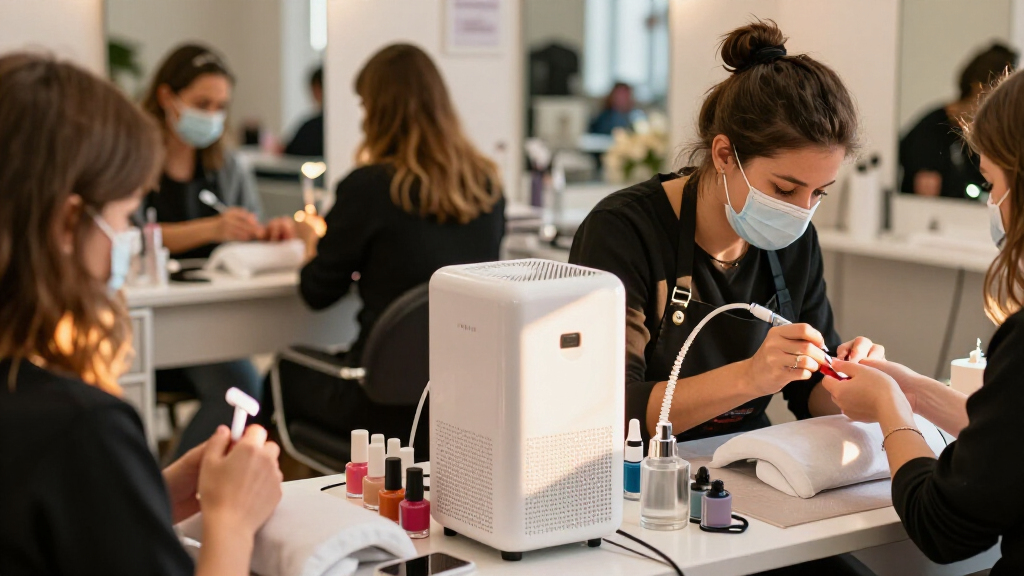
I ranked these five models for beauty-room use, where hair and dust may be visible, services can add odors or fine particles, and fan noise can interrupt conversation. I focused on whether each listing gives buyers a useful measure of cleaning capability, how its intake and filter details fit common room conditions, and whether controls allow the purifier to run without constant attention. I also weighed practical concerns such as filter maintenance, size, and operating noise where those figures were provided.
I did not treat every coverage figure as equivalent. A square-foot claim paired with an hourly cleaning time describes a different pace from a smaller room rating supported by CADR data. For that reason, I gave more weight to specific CADR or air-change information than to large coverage numbers on their own. AHAM verification, particle-size claims, and stated noise ranges also help distinguish the models, but none of those details can tell me how a particular purifier will perform in every room layout or during every beauty service.
The ranking reflects the information supplied for these products, not hands-on testing. I have not assumed that general particle filtration captures every salon chemical, vapor, or strong fragrance. Buyers should check that the chosen model’s filter suits the pollutants they want to reduce, follow its replacement guidance, and keep the intake and exhaust unobstructed. I gave each purifier a distinct role so readers can compare a smart all-rounder, a large-room option, simpler value-oriented models, and a compact pick rather than treating them as interchangeable.
Factors to Consider When Choosing Air Purifier For Beauty Rooms
I’d start by defining the room and the pollutants you want to address. A purifier may capture particles such as dust, hair, and pollen, while control of odors or product-related gases depends on its filter and the specific contaminant. The supplied claims do not establish that any of these models removes every vapor produced during beauty services.Match room size to cleaning pace
Coverage numbers need context. The Afloia KILO lists four air changes per hour up to 374 square feet, while its 1,500-square-foot claim refers to one hour. Blueair also gives two distinct rates: 439 square feet in about 12.5 minutes and up to 2,107 square feet in an hour. I would prioritize the faster, clearly described room-cleaning rate that suits the space rather than selecting by the largest number. For a larger room, the Vital 200S-P’s AHAM verification and separate CADR figures provide a different basis for comparison.
Choose for the air concerns in your room
For airborne particles such as dust, pollen, pet dander, and smoke, compare the stated filtration details and CADR values. The Vital 200S-P and Core 300-P list pollutant-specific CADR figures; Blueair provides a particle-capture claim and CADR of 250 for smoke, dust, and pollen. For odors, check the exact filter construction and intended use, rather than treating a general particle filter as a complete solution for gases or strong beauty-product smells. Ventilation and appropriate service practices remain relevant.
Keep noise and controls in the workflow
Noise can affect conversations, consultations, and close-up work. Blueair gives a 23–50 dB range, the Core 300-P lists 24 dB in Sleep Mode, and Afloia lists a 22 dB sleep mode. These figures describe different operating conditions, so they are not a direct comparison of every fan setting. If you want the purifier to react without manual changes, Blueair offers sensors and automatic fan adjustment. If you prefer simple controls, the Core 300-P’s timer and light controls may be sufficient.
Plan for filters and routine cleaning
Every purifier needs maintenance. The Core 300-P recommends filter changes every six to eight months, Afloia every four to six months, and Blueair includes filter-life tracking. The Vital 200S-P offers several replacement filter options, while Afloia’s washable pre-filter can help capture dust and hair before they reach the main filter. Check the manufacturer’s instructions for cleaning, replacement, and the specific filter’s purpose. A washable pre-filter does not remove the need to replace the main filter when directed.
Allow room around the intake
Placement affects whether the unit can draw and return air freely. The Blueair’s 360-degree intake offers more flexibility, while the Vital has traditional and U-shaped inlets. Leave the clearances specified by the manufacturer and avoid blocking the unit with a treatment cart, curtains, or storage. A compact model such as the Core Mini-P is easier to place near a station, but its supplied specifications do not establish coverage for an entire room.
Frequently Asked Questions
Which air purifier is my best starting point for a beauty room?
I’d start with the Blueair Blue Pure 311i Max if the room is a working treatment space and you value automatic fan adjustment, app control, and a stated cleaning rate. For a larger room, the LEVOIT Vital 200S-P is a stronger fit because it lists AHAM verification and separate CADR figures. The right choice depends on room size, cleaning pace, and whether you want connected controls.
Can these purifiers remove beauty-product fumes and odors?
The supplied information supports claims about particles such as dust, pollen, smoke, hair, and pet dander, and some models list activated carbon or odor-focused replacement filters. That does not establish removal of every vapor or chemical used during beauty services. I would check the exact filter’s stated purpose and follow product safety and ventilation guidance rather than relying on a particle-capture figure as proof of gas removal.
How should I compare the coverage claims?
I would compare both room area and cleaning time. Afloia’s up-to-1,500-square-foot figure is stated for one hour, while its four-air-changes-per-hour figure applies to rooms up to 374 square feet. Blueair also pairs a quicker 439-square-foot rate with a much larger hourly figure. Those figures describe different cleaning paces, so I would match the faster, more relevant rate to the room instead of selecting by the largest area alone.
Which model is better for a small beauty station?
The Levoit Core Mini-P is easiest to place in a tight spot because it measures 6.5 × 6.5 × 10.4 inches. I would treat it as a small-station option, though, because the supplied details do not include a coverage area or CADR. For a full treatment room where room-cleaning capacity matters, the Core 300-P offers more useful comparison data, while Afloia provides an air-change figure for its rated room size.
How often should I replace or clean filters?
Follow the manufacturer’s instructions for the specific model and replacement filter. The Core 300-P recommends replacement every six to eight months, and Afloia recommends replacement every four to six months; Blueair includes filter-life tracking. Afloia’s washable pre-filter can be cleaned as directed, but it does not eliminate replacement of the main filter. Usage, room conditions, and service activity may affect how quickly filters need attention.
Conclusion
For a beauty professional who wants the most convenient all-round setup, I’d choose the Blueair Blue Pure 311i Max for its sensors, app controls, and stated noise range. If the room is large and verified particle-cleaning data matters most, I’d move to the LEVOIT Vital 200S-P. For a single treatment room without a need for smart features, the Core 300-P offers a useful balance of CADR details and quiet sleep operation. I’d pick the Afloia KILO when a washable pre-filter and quiet mode are the priorities, while the Core Mini-P is best reserved for a compact station rather than assumed to clean an entire room. Before buying, I’d match the purifier’s stated cleaning pace to the space and check that its filter addresses the specific air concerns in the studio.
Halloween Picks
halloween
As an affiliate, we earn on qualifying purchases.